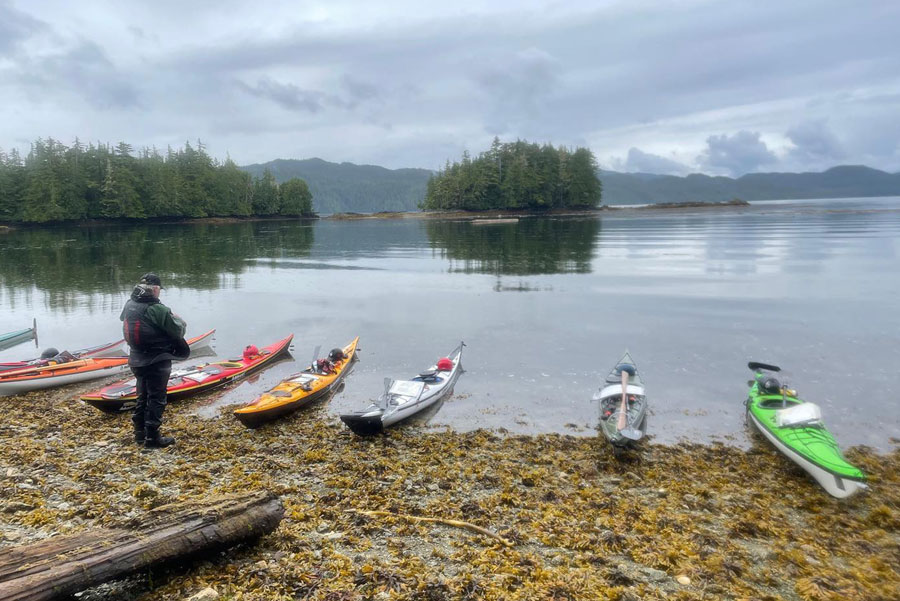
When people think of paddling in BC, they’ll typically envision canoes and paddleboards gliding across calm lakes, rafts and kayaks bouncing down fast-moving rivers, and sea kayaks bobbing between coastal islands. However, they are only the tip of the iceberg when it comes to the different ways you can paddle British Columbia’s waterways. Other forms of paddling, such as outrigger canoes, dragon boats, and pack rafts, can open doors to unique experiences on the water. This article will look at a few of these forms and share some destinations around BC that are perfect for these alternative forms of paddling.
OUTRIGGER CANOES
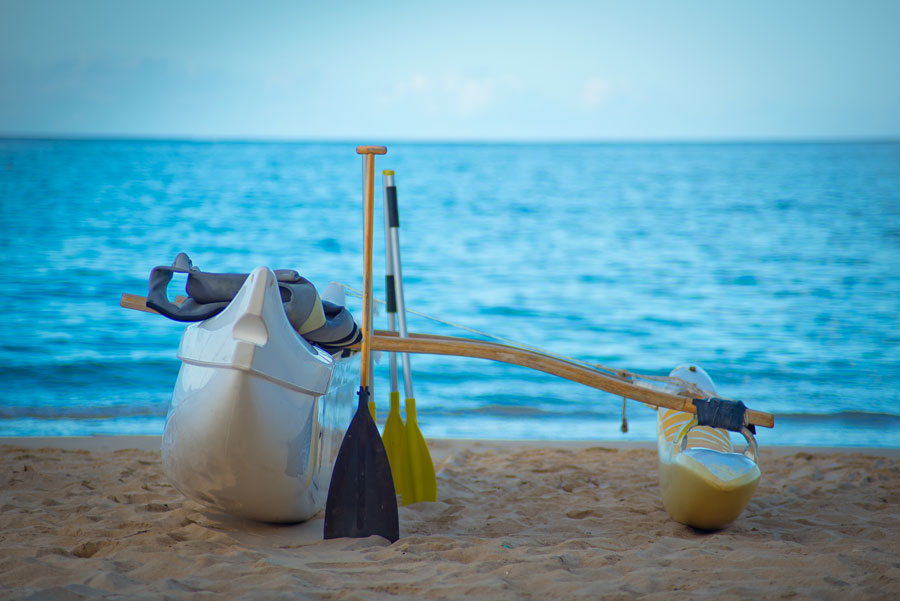
The origin of the outrigger canoe can be traced back over a thousand years to the South Pacific, where the Austronesian Peoples used the boats for ocean travel between islands such as Polynesia, New Zealand, and Madagascar. An outrigger canoe is like a regular canoe but with one or more lateral floating supports (outriggers) attached to the main hull. The outriggers provide greater stability than traditional canoes or kayaks, allowing safe paddling in rougher waters. In some cases, outrigger canoes are made longer and narrower, making them faster in the water without sacrificing stability.
The Kelowna Paddle Centre (https://kelownapaddlecentre.ca/oc23/), located at the Pandosy Waterfront Park on the shores of Okanagan Lake, is the perfect place to try outrigger canoeing. From May through September, they offer a range of programs for total beginners and experts alike, with options for single-person vessels and larger group vessels
DRAGON BOATING
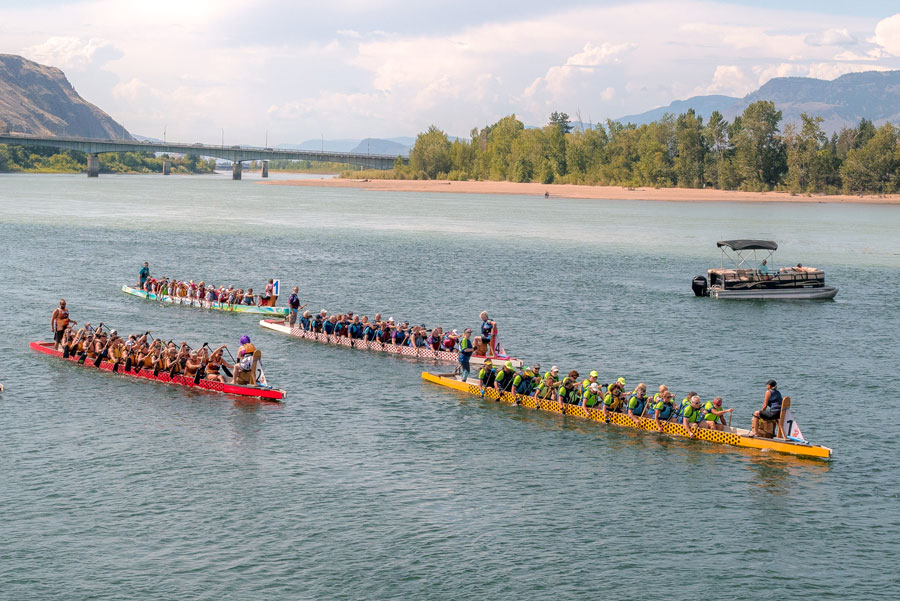
Dragon boating is unique, as it blends cultural activity and sport. Its origins can be traced back to ancient Chinese myths and legends. In major races, dragon boaters summon the spirit of the dragons from their high perches in the remote mountains and clouds. These boats are traditionally made of teak with a mythical Chinese-style dragon head attached to the boat’s prow and a dragon’s tail attached to the stern. While for some, the sport is a recreational activity, for others, it is a high-performance sport with races timed down to the millisecond. Dragon boating made its first North American appearance at the 1986 World Exposition on Transportation and Communication at False Creek in Vancouver. Now, North America’s most prominent race, the Concord Pacific Dragon Boat Festival, is held at False Creek every year.
Those wanting to get into dragon boating could check out one of the many local clubs across the province (https://register.dragonboat.ca/clubs/). Or, if you want to try it out without joining a club, the Nanaimo Paddling Centre on Vancouver Island (https://nanaimopaddlingcentre.ca/upcoming-courses-clinics/) offers classes for beginners!
PACKRAFTING
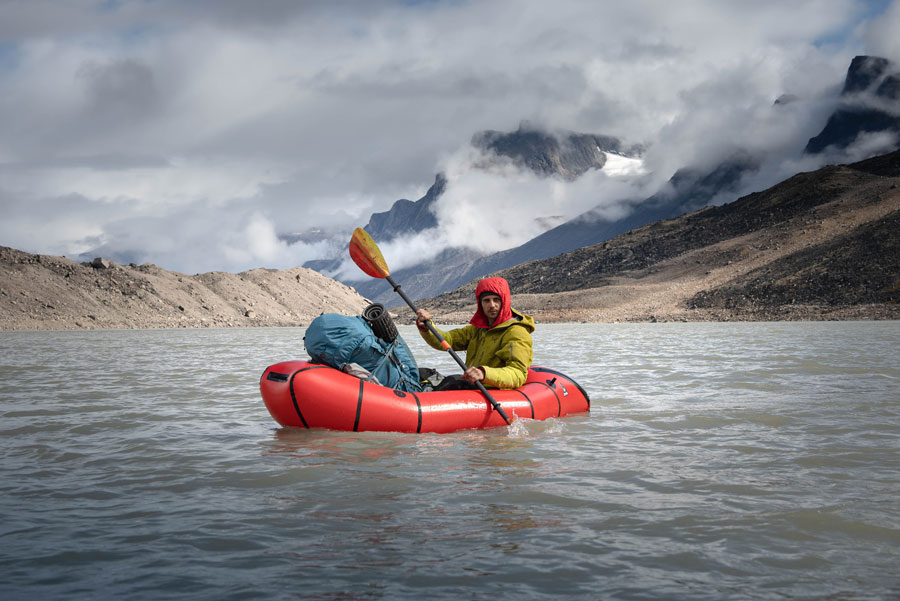
Packrafts are small inflatable rafts built for backcountry adventures. Some rafts weigh as little as 2.25 pounds, and these rafts can fit in backpacks or on bike packing rigs to make for ultimate multi-sport adventures. For some, this opens doors for hiking-paddling combo trips, like one man (https://www.diypackraft.com/matts-vancouver-island-traverse-2020/) who paddled 250km and hiked 525 km to travel the entire length of Vancouver Island. For others, packrafts are a means to open up access to remote whitewater that otherwise would only be accessible by a helicopter drop with traditional whitewater kayaks. Packrafting doesn’t all have to be extreme. A pack raft could also be used to add paddling to the itinerary on an overnight hike, such as Fish Lake in the Top of the World Provincial Park near Cranbrook.
If you are interested in trying out pack rafting before buying one, Ascent Fraser Valley Guides and Mountain School (https://ascentfv.com/packrafting/ ) offers beginner-friendly pack rafting courses that will teach you all the skills you need to plan and execute your own trips safely. You’ll learn to paddle, understand how rivers work, and how to recognize hazards and mitigate risks. They also offer specialty courses, private coaching, and guiding services for anyone seeking support in tackling a bigger objective!
ROWING
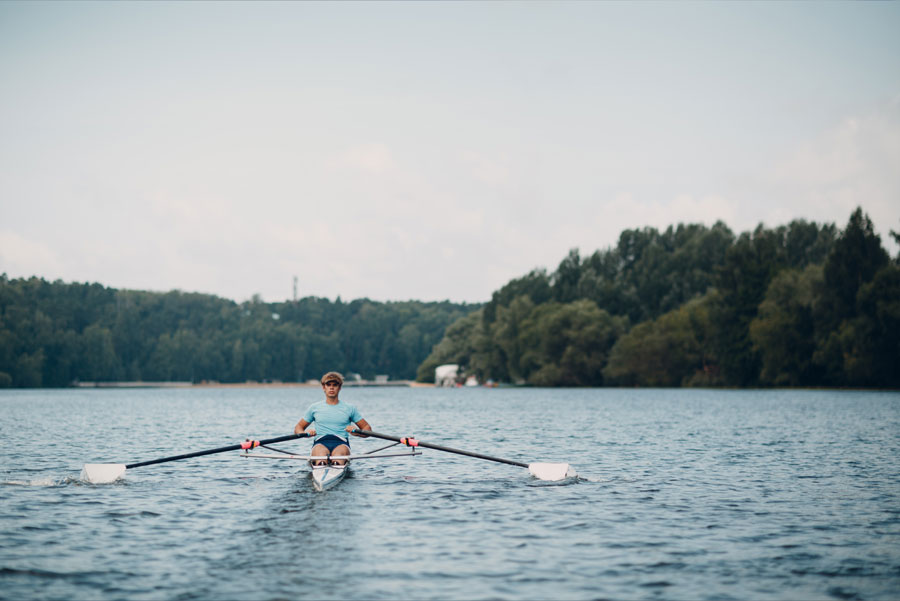
In its simplest definition, rowing is the propulsion of a boat with oars fixed to the boat, which can be traced back to Galleys being used on the Nile River in Ancient Egypt. The sport of Rowing, as we know it today, can be traced to early races on the Thames River in England during the 18th century. Modern rowing boats, often called shells, are long, narrow vessels designed for speed and efficiency on the water. The two styles of rowing that are usually practiced include sculling, where each rower uses two oars, one in each hand, and sweep rowing, where each rower uses a single oar held with both hands. Rowing combines strength, technique, and teamwork to achieve synchronization with others on a rowing team, allowing the boat to move at high speeds through the water. Many rowers love the sport for its meditative qualities that are found when you reach a state of harmony with your teammates and the water.
If you are interested in learning how to row, the Salt Spring Island Rowing Club offers learn-to-row courses on the calm waters of St. Mary’s Lake (https://www.saltspringrowing.ca/learn-to-row). They also offer coastal rowing courses for rowers who are already experienced on flat water and want to try something new! Similar courses are also offered by the Vernon Rowing and Dragon Boat Club (https://www.vernonrowinganddragonboat.com/ltr-2024.html) and the Deep Cove Rowing Club in North Vancouver (https://deepcoverowingclub.com/adult-learn-to-row-program/).